
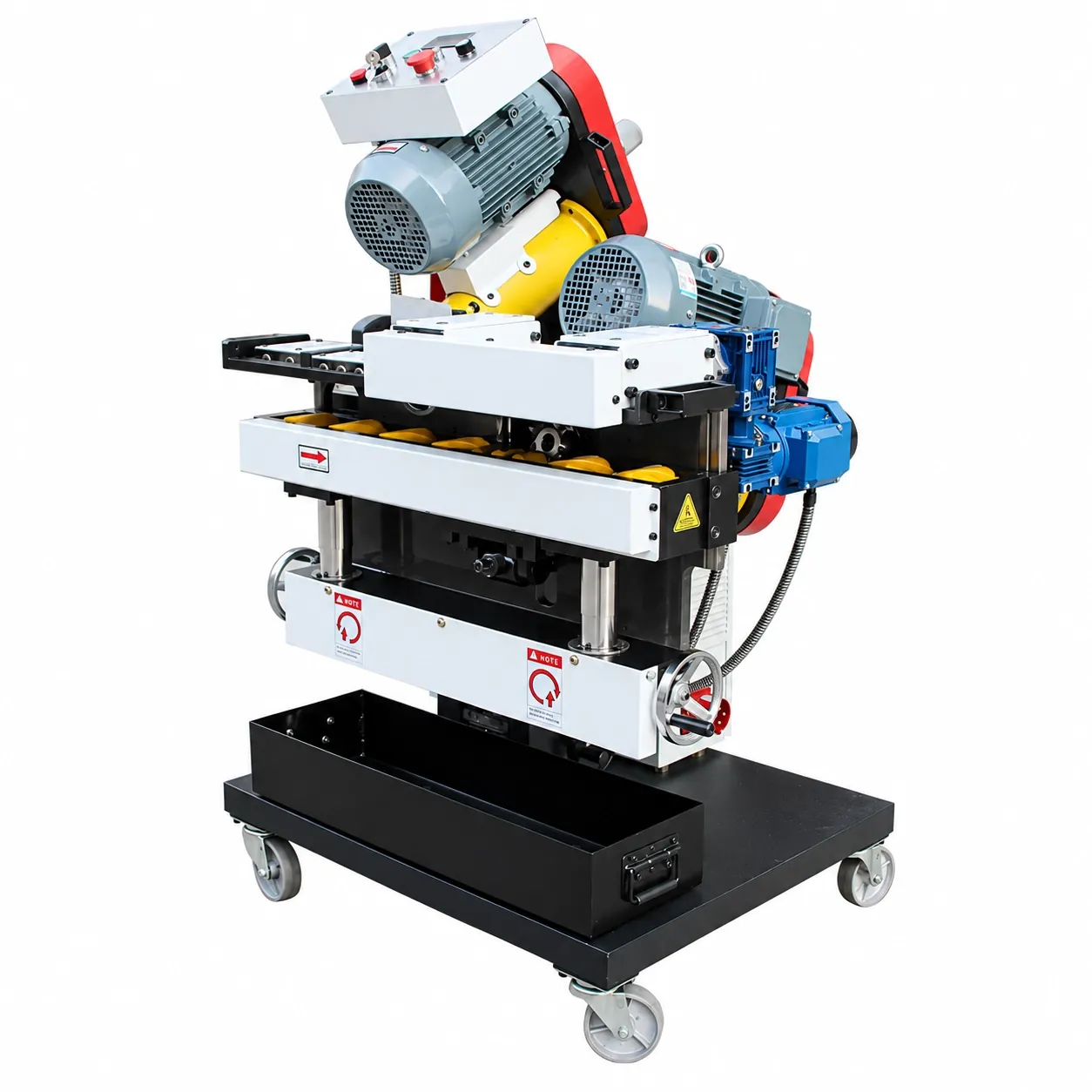
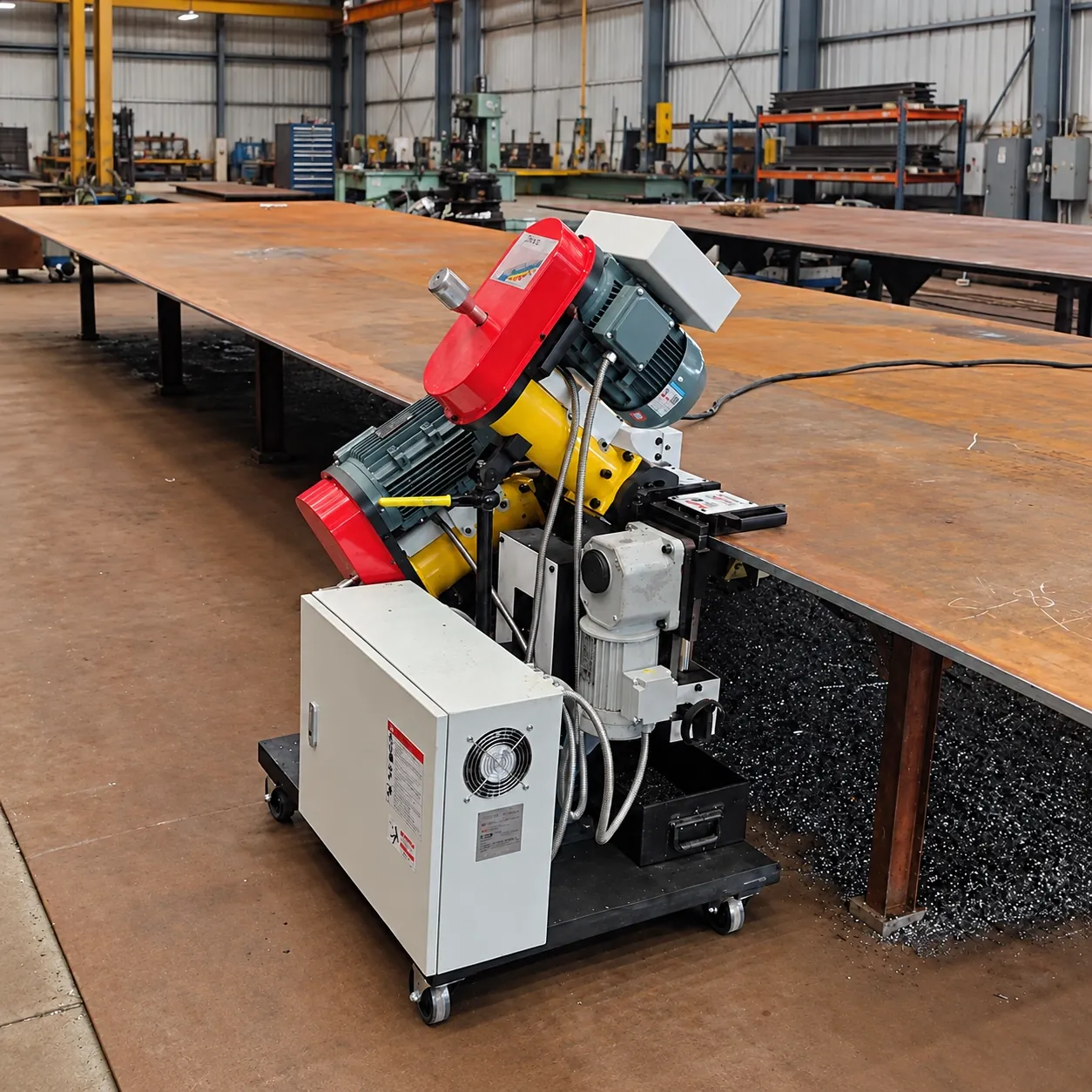
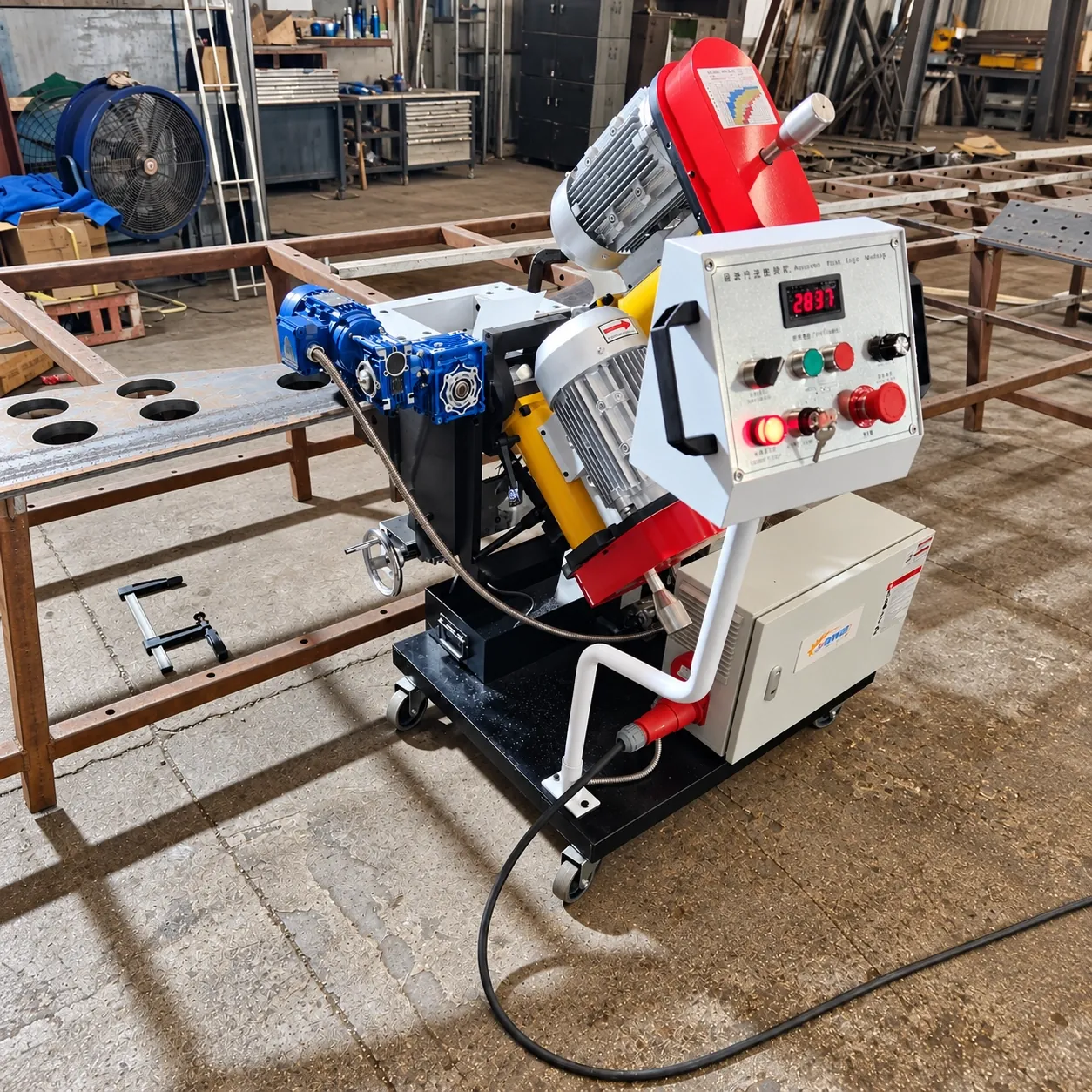
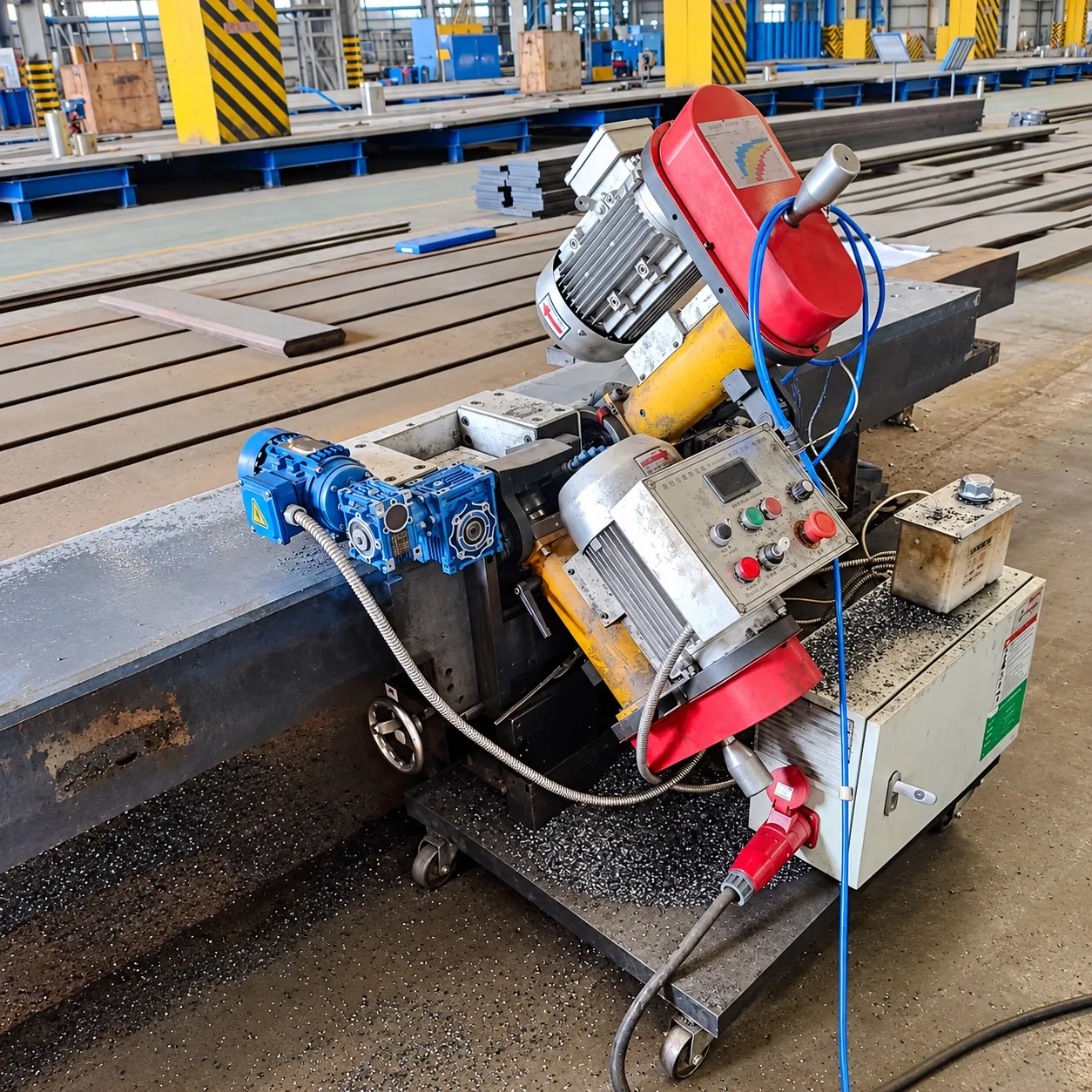
DMM-1232 Double-Sided Plate Edge Milling Machine
Twin-head plate edge miller that bevels the top and bottom of the edge in the same pass — X and K weld preps on 4 – 55 mm plate without turning the plate over. The top head sets 0° – 45°, the bottom 0° – 60°, and each cuts bevel width up to 40 mm; at 0° it mills a straight edge for trimming. Built for medium to thick plate in production shops.
Specifications.
| DMM-1232 Simultaneous top + bottom · 4 – 55 mm plate | |
|---|---|
| Plate thickness | 4 – 55 mm (thinner plate: stack two and cut together) |
| Bevel angle | Top head 0° – 45° · bottom head 0° – 60° (adjustable) |
| Bevel width (each face) | 0 – 40 mm (15 mm in a single pass) |
| Bevel depth | 1 – 25 mm |
| Faces cut per pass | 2 — top and bottom simultaneously |
| Weld preps produced | X-groove · K-groove · double-V · 0° straight-edge milling |
| Beveling speed | 0.8 – 1.5 m/min |
| Surface finish | Ra 3.0 – 12.0 μm |
| Main motor | 6 kW (2 × 3.0 kW) · 1410 rpm |
| Feed motor | 1.1 kW (2 × 550 W) |
| Power supply | AC 380 V · 50 Hz |
| Gross weight | 320 kg |
| Standard supply | Machine · 2 boxes of blades · disassembly tool set · operating manual |
| Quote this model |
The cost of a double-sided bevel is the plate turn-over, not the cut
On an X or K joint the machining itself is not what takes the time. Cutting the first face is a normal pass; what follows is the expensive part — unclamp, crane the plate over, re-square it, re-clamp, re-zero, cut again. On plate over half a tonne that handling cycle routinely costs more than both cuts together, and every re-fixture is another chance for the two bevel faces to end up misaligned about the plate centreline. The DMM-1232 puts a cutter above and below the edge and drives both from the same feed axis. Small plate feeds itself through the stationary machine; on large plate the plate stays put and the machine travels along the edge. Either way the edge passes the heads once, and because the two faces are cut in the same setup by heads referencing the same datum, they stay symmetric without anyone measuring for it.
Built for the job site.
Where this series earns its keep.
Pressure vessel shell and heavy structural plate
X and K weld preps on vessel shell plate and heavy structural sections, where double-sided geometry is specified and plate weight makes turn-over the dominant cost.
Hull and deck plate
Double-sided prep on heavy hull and deck plate, where crane availability rather than machining speed sets the pace of the edge-prep line.
Boiler and penstock plate fabrication
Symmetric double-V prep on thick-wall plate for boiler drums and penstock sections, where joint symmetry affects distortion during welding.
Common questions about the DMM-1232.
Can't find your answer?
Which weld preparations can it produce?
Can the top and bottom angles be set independently?
How wide and deep can each bevel be?
How does this compare with running a single-sided machine twice?
What if my plate is thinner than 4 mm or thicker than 55 mm?
What comes in the standard supply?
Other plate beveling machines.
Get a quote within 24 hours.
Send us your spec sheet, pipe schedule, or drawing — our engineers reply with pricing, lead time, and recommended models.
- 01Send specs & drawings
- 02Receive quote within 24h
- 03Confirm & manufacture