
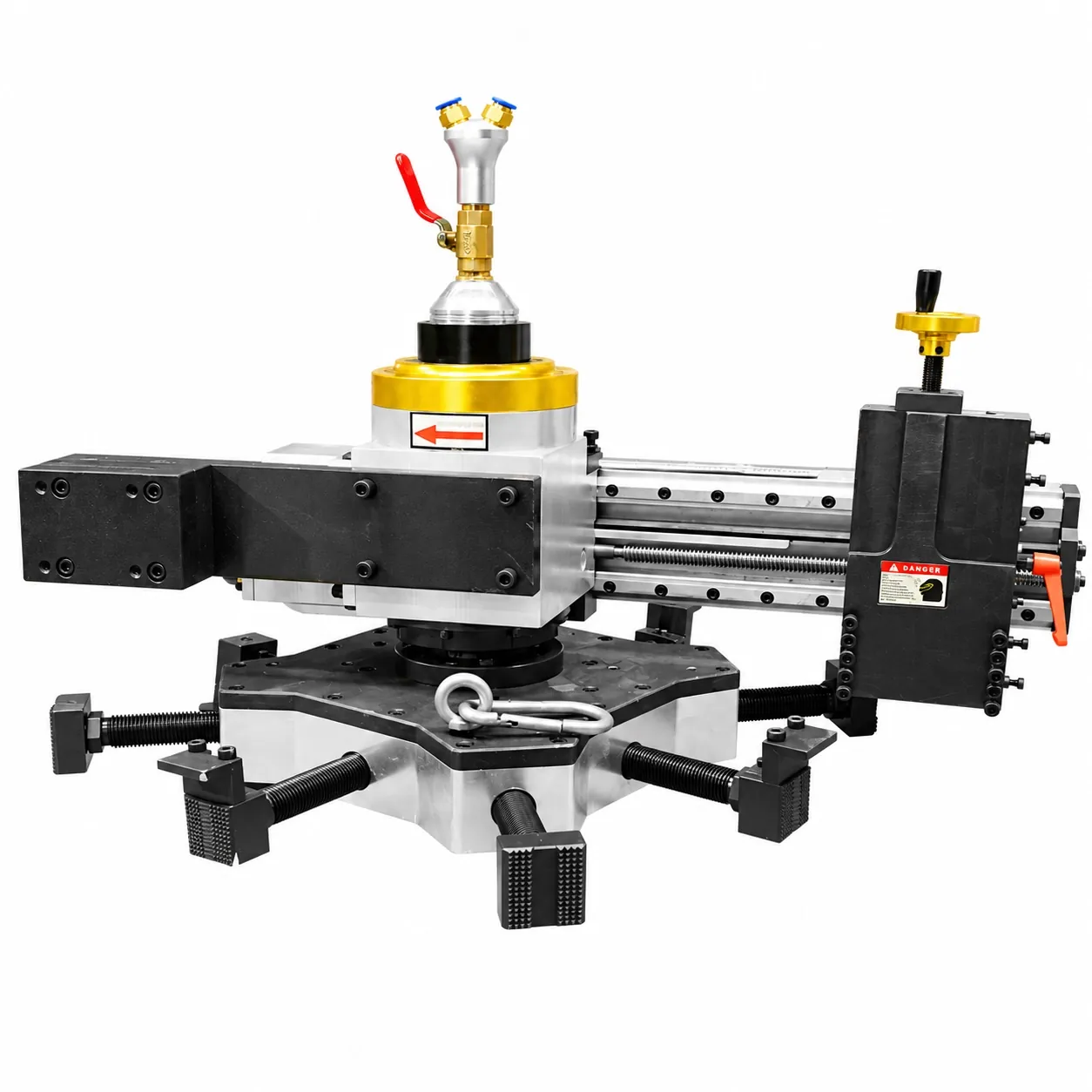
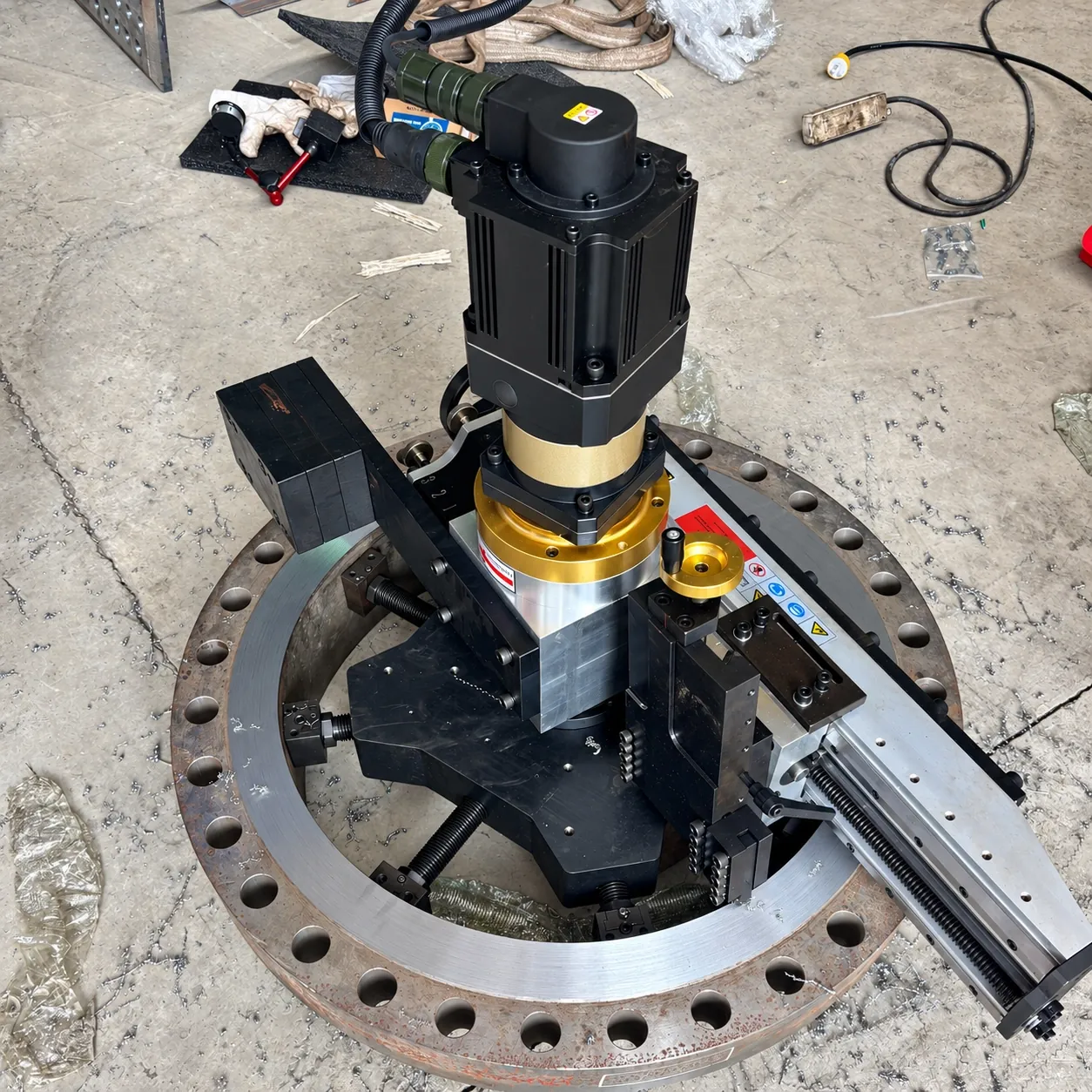
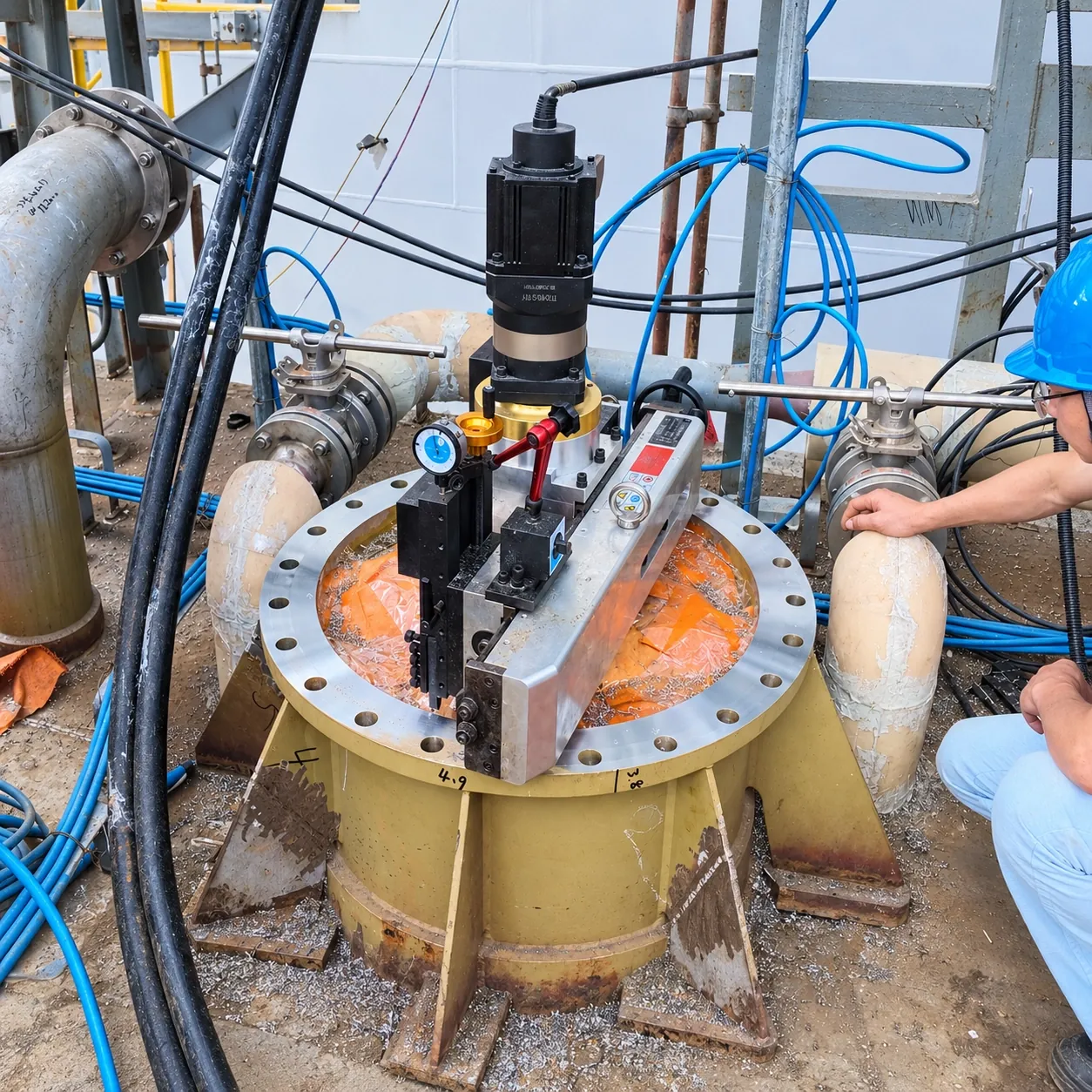
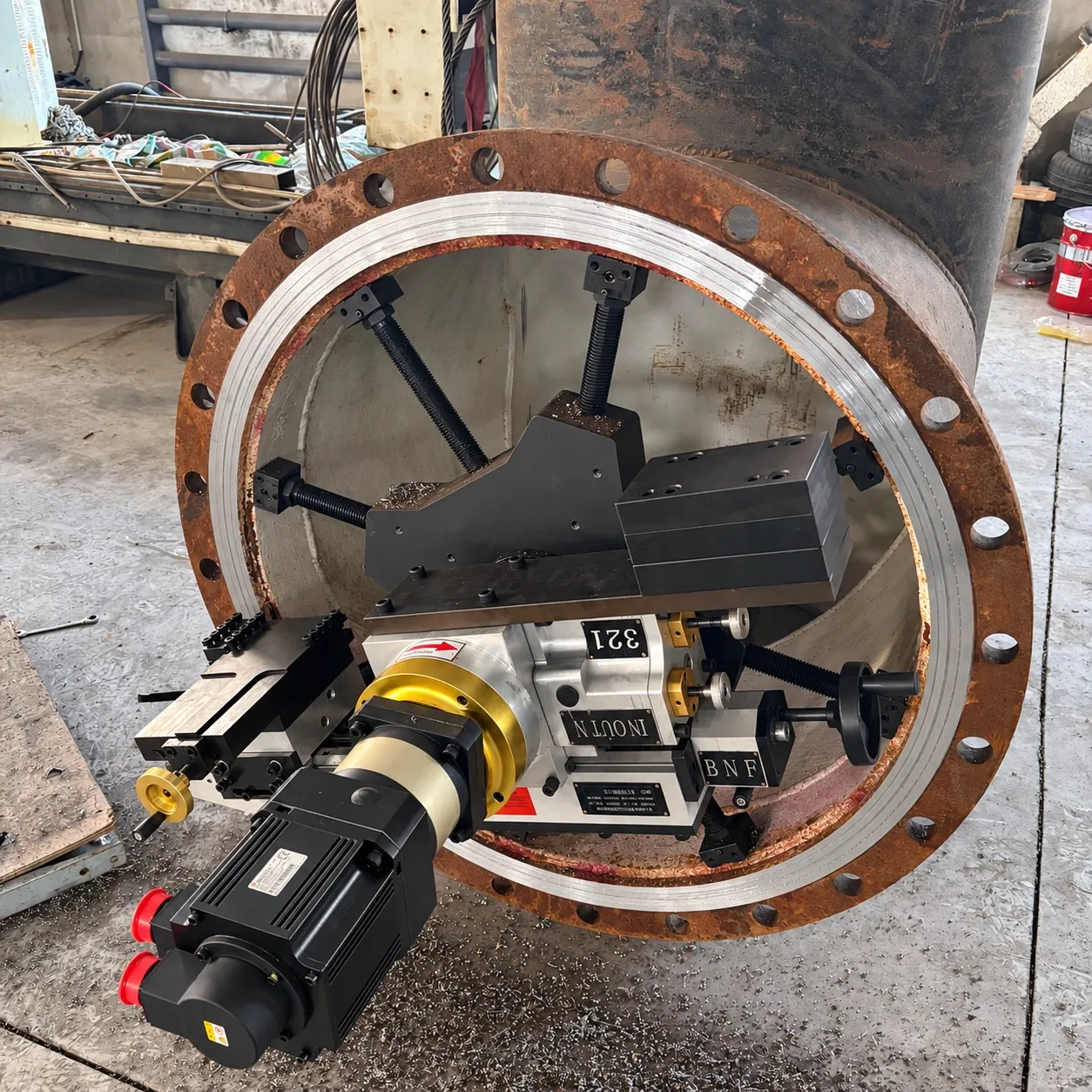
Portable Flange Facing Machine (ID-Mounted, On-Site)
ID-mounted portable flange facer that resurfaces damaged sealing faces in situ — without removing the flange from the pipe. Cuts RF spiral serration, FF flat finish and RTJ grooves per ASME B16.5. Pneumatic, hydraulic or CNC servo drive across 5 size frames Ø 50 – 3000 mm.
Pick your size — 5 models in the series.
| WFP-610 Pneumatic · 50 – 610 mm OD | WFP-1000 Pneumatic · 160 – 1000 mm OD | WFH-1650 Hydraulic · 500 – 1650 mm OD | WFS-2000 CNC Servo · 690 – 2200 mm OD | WFS-3000 CNC Servo · 1150 – 3000 mm OD | |
|---|---|---|---|---|---|
| Facing range (flange OD) | 50 – 610 mm | 160 – 1000 mm | 500 – 1650 mm | 690 – 2200 mm | 1150 – 3000 mm |
| Mounting range (bore ID) | 50 – 508 mm | 158 – 820 mm | 500 – 1500 mm | 690 – 2000 mm | 1120 – 2800 mm |
| Drive type | Pneumatic | Pneumatic | Hydraulic | CNC Servo | CNC Servo |
| Rotation speed | 0 – 42 r/min | 0 – 33 r/min | 0 – 22 r/min | 0 – 20 r/min | 3 – 12 r/min |
| Sealing-face profiles | RF · FF · RTJ | RF · FF · RTJ | RF · FF · RTJ | RF · FF · RTJ | RF · FF · RTJ |
| Tool post | 360° swivel | 360° swivel | 360° swivel | 360° swivel · CNC | 360° swivel · CNC |
| Quote this model |
How an ID-mounted portable flange facer works
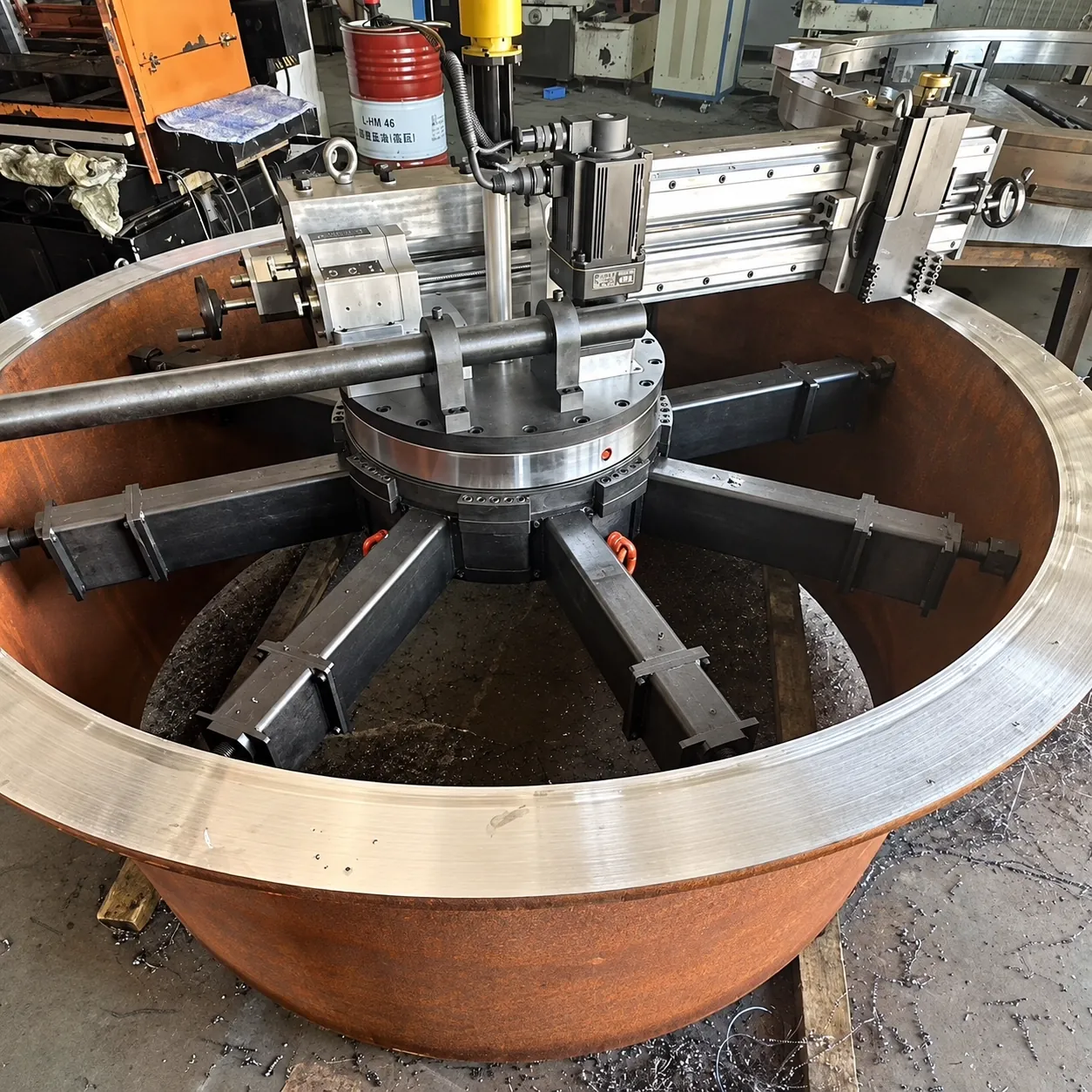
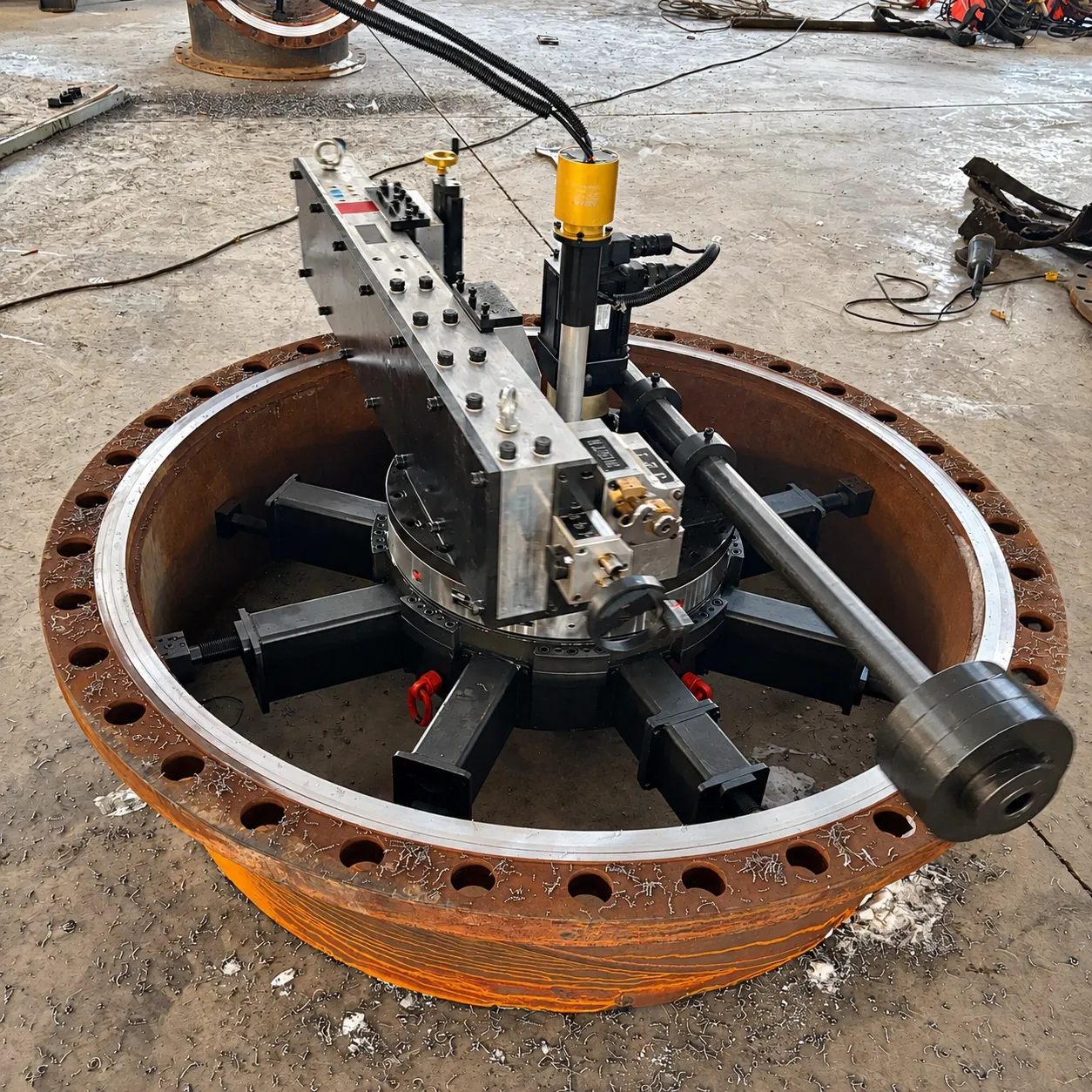
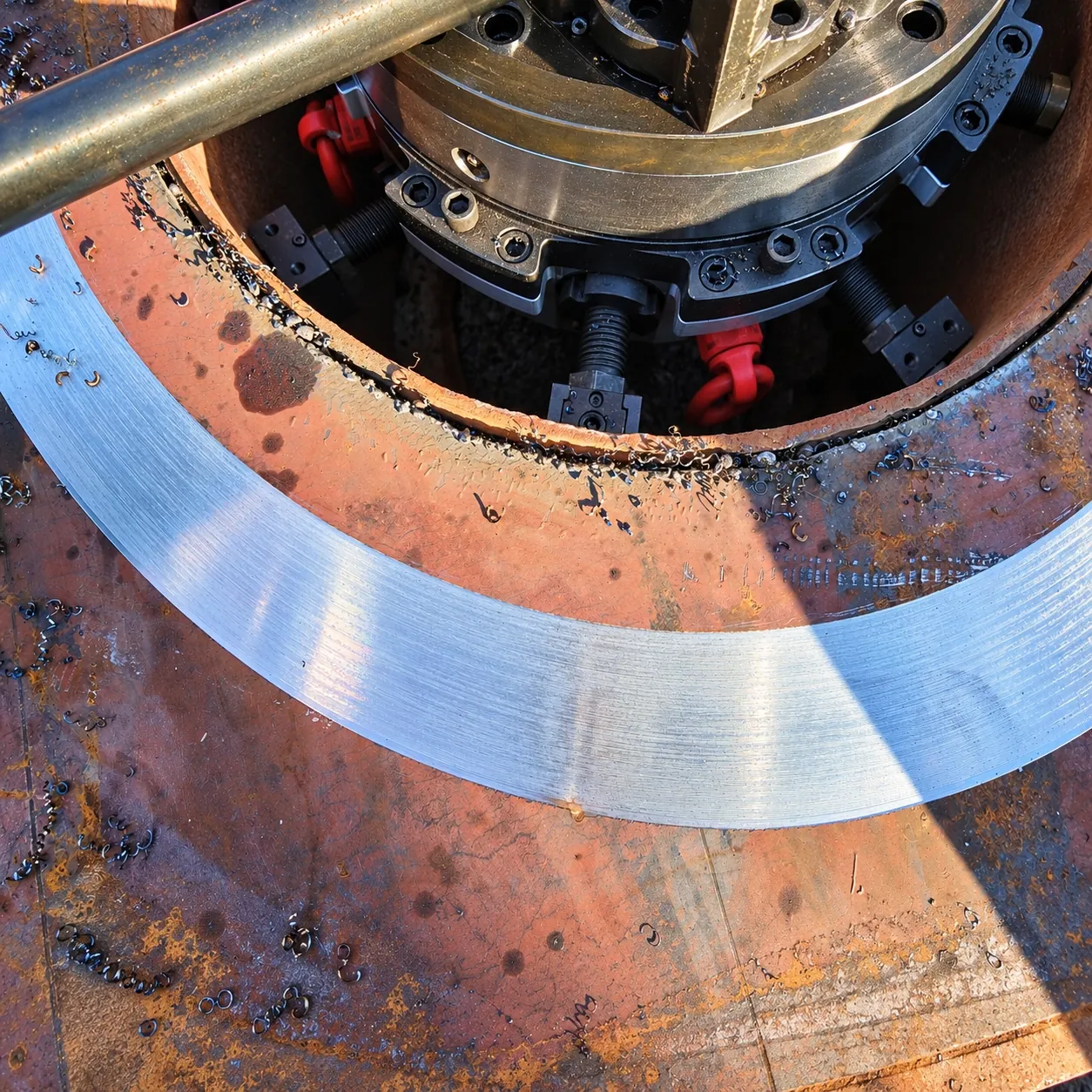
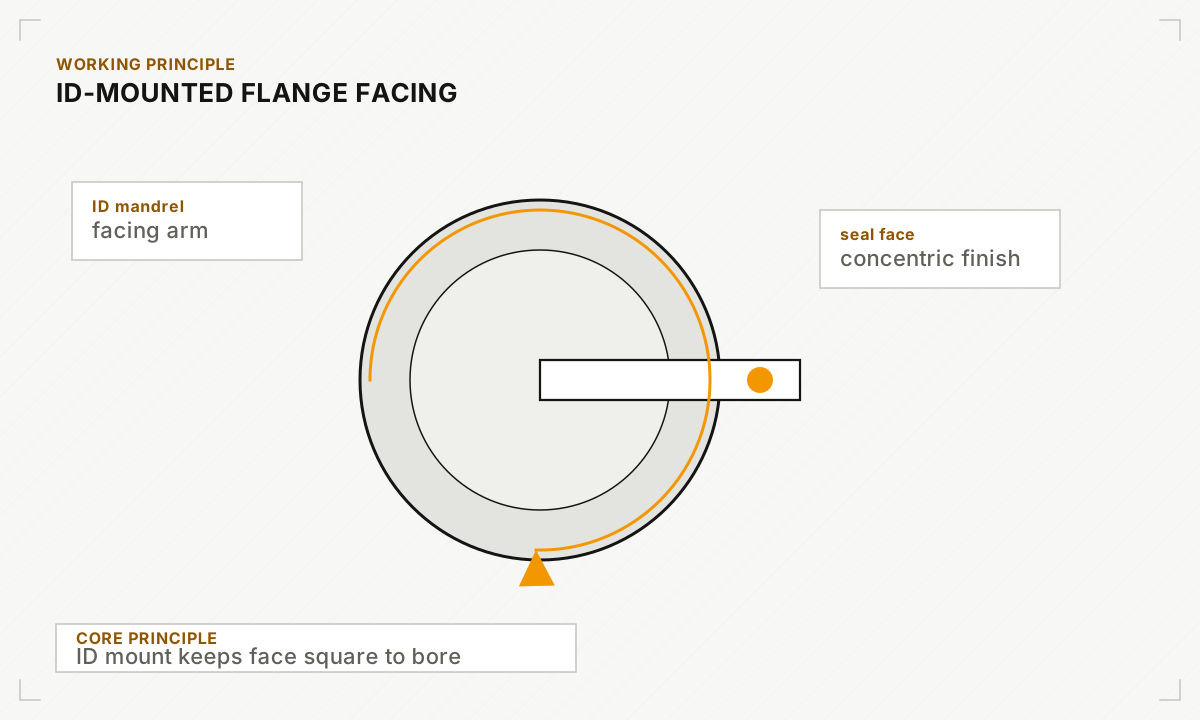
An expanding mandrel passes into the pipe bore behind the flange and grips the ID — referencing the machine axis to the bore centerline. A rotating tool arm carries a radial slide and tool post out across the flange face. Because mounting is referenced to the pipe ID (not the flange OD or the bolt circle), the resurfaced face is automatically square to the pipe axis — which is what the gasket seats against under bolt-up load. The 360° swivel tool post lets the operator cut RF spiral serration, FF flat finish or RTJ groove geometry per ASME B16.5 / B16.20 without removing the flange from the line. Preloaded braking on the radial slide eliminates chatter when the tool crosses bolt holes — the typical failure mode of less-rigid facers.
Built for the job site.
Where this series earns its keep.
Refinery & pipeline flange resurfacing
On-site restoration of corroded RF and RTJ flanges on process and transmission piping. WFP pneumatic variant for Class 1 Div 2 / ATEX zones during turnaround windows.
Steam turbine & valve flange machining
Resurfacing horizontal-joint flanges on steam turbine casings, HP valve bodies and boiler header connections — where flange face squareness directly controls steam leak rate.
Stern-tube, bulkhead & marine system flanges
Resurfacing stern-tube flanges, bulkhead penetrations and engine-room piping flanges in dry-dock and afloat-repair contexts.
Common questions about the WFP / WFH / WFS Series.
Can't find your answer?
When is on-site facing better than removing the flange to a workshop?
How do I pick between WFP, WFH and WFS?
Can it cut a fresh RTJ groove or only restore existing ones?
What surface finish does it deliver on an RF face?
Get a quote within 24 hours.
Send us your spec sheet, pipe schedule, or drawing — our engineers reply with pricing, lead time, and recommended models.
- 01Send specs & drawings
- 02Receive quote within 24h
- 03Confirm & manufacture